

I grew up in the deep south: Lake Charles, Louisiana (LA) to be exact, which is about a 50 minute drive to the Gulf of Mexico. I never thought much about race or racism, because for no other reason than I was a child. I knew of tension between white and black folks, but I didn’t really concern myself because I wasn’t “racist” . . . because I was nice to everyone. I honestly believed that.
At 18, I moved with my parents to Shreveport, LA which was approximately 3 hours due north and which seemed like a world away. The next year Shreveport became a racially charged hot spot. Between August and December 1988, three black Northwest Louisiana men had been killed by white people. 17 year old Darren Martin was shot in the parking lot of a Shreveport restaurant in August by a 19 year old white man. In September, David McKinney was shot by a 17 year old white girl looking to purchase drugs in Cedar Grove which sparked a riot in the neighborhood for two days. Buildings were burned, rocks were thrown and the police cordoned off the neighborhood. In December, Loyal Garner, Jr (a Florien man) was beaten to death during an arrest for drunk driving in Hemphill, TX. Three law officers were charged, but later found innocent. I tell you about these events because as a 19 year old, I was terrified. I didn’t really follow the stories at the time to understand that white people had been killing black people. All I saw when I watched the news was angry black people burning and looting things in the city that I lived. I didn’t understand or feel compelled to understand. My whiteness allowed that. I was scared of the actions of the black people. I didn’t educate myself to see what was happening. I just thought I had moved to the scariest place in Louisiana, but, I didn’t think I was racist. I locked my car doors if I was alone and a black man walked by. I clutched my purse tighter when a black man was walking towards me. I wasn’t racist, I was just being cautious. UGH, so wrong!
Over the years, I lived in my bubble of unknown/unacknowledged, white privilege. Heck, I didn’t even know the words “white privilege”. I still lived under the assumption that I was a nice person because I was nice to everyone. I couldn’t be racist, because I had black friends. It wasn’t until my late 40’s that I started to acknowledge that things weren’t quite right. I started reading and educating myself about race issues. A book by Catrice Jackson, “Antagonist, Advocates and Allies: The Wake Up Call Guide for White Women Who Want to Become Allies with Black Women”, helped open my eyes to the unintentional racism that I, as a white woman, had been perpetuating. It was a start. In 2016, I was attending the Shreveport Mayor’s Women’s Commission Style Show Luncheon when a friend of mine Krystle Beauchamp started having a conversation about race. I had mentioned that I recently learned that it wasn’t appropriate to ask black people to teach me. Krystle, being Krystle, said I could always ask her anything. I still remember that to this day, but try to respect that I need to educate myself. She then told me about a 6-week Dialogue on Race class given by the YWCA. She thought that I might benefit from attending. I signed up that week to attend. In early 2017 I attended my first Dialogue on Race session and my lie fwas forever changed. I have come to realize unintentionality is no excuse for my actions. I can not change who I was, but I can change who I will be. The silence and inactions of my life are dangerous to people of color and have to change if I am to help stop the continuance of racism. Racism is only going to change if white people take a stand. We must learn to listen, and listen to learn.
This past week, George Floyd was murdered by police officers who ignored his pleas to breathe. I can never unsee and unhear Mr. Floyd plead for his life and call out for his mom. Now more than ever I want to change who I will be when it comes to showing up for people of color. Here are things that I am committed to doing:
- Be uncomfortable: I will not let discomfort get in the way of having honest discussions/dialogues about race. This is one of the most important things I’ve learned. I have to allow discomfort in order to grow.
- Be authentic: I can not change who I was, but I can change who I will be. This only works if I am honest and transparent. I will always have more work to do. I have not eliminated all of the bias and prejudice in my life, but I truly want to change that.
- Educate myself: I will never be done learning. Everyday search for information on ways that I can help. I will challenge myself to to think beyond my current understanding of issues.
- Understand: I will continue learning to understand the differences between bias, prejudice, discrimination and racism and how they affect our world.
- Do not invalidate: I will listen to my Friends of Color and will not tell them they are wrong or try to insert my experience.
- Speak up: When I see or hear an injustice, I will speak up. This is a particularly difficult one for me because my brain doesn’t work very fast when it comes to speaking. I can write all day, but my words don’t come when I’m speaking. No excuses though!
- Check on my friends: People of color have trauma y’all. Check on your friends. Let them know you are concerned. Ask if they need anything. Help when you can.
- Be wrong: I will be willing to be wrong. If someone calls me out, I will listen and not give excuses.
- Don’t be afraid: I will work to eliminate the irrational fear that I have built over the years. I have found that when you reach out and connect with people, fear can be eliminated if you are coming from a place of authenticity.
- I’m gonna make mistakes: I will make mistakes. I will be embarrassed. I will learn from those mistakes.
I know there is so much more to do and I hope you will join me in making change. We can change who we will be by speaking up and showing up for our friends of color.
That Just Happened!!
Robin Williams
On a side note: The YWCA Dialogue on Race was a sort of jumping point for me. It impacted me on such a deep level. I want to help more people be able to attend. The cost to attend the 6-week session is $25. Paying for one person would be cool, but paying for many people would be great. So, I designed a t-shirt to sell and the entire profits will be donated to assist in paying the attendee fee for participants wishing to attend the Northwest Louisiana YWCA Dialogue on Race. If you would like to wear this shirt as a commitment to end bias, prejudice, discrimination and racism, order one now.





 So how does it help Holiday Lanes? It gives us the opportunity to invest in the community. We learn about other organizations and it allows us to be a resource for those people related to the organizations.
 d graders is way different than volunteering on a committee. I think this is going to give me energy and make me better at my job.


 Open your closet. Let’s get real. How many items in there are you actually wearing? If you are like me, there are still a few pieces hanging out from the 80’s. So when my friend Meg invited me to a clothing swap at her residence, I thought “what’s a clothing swap?”. And then I thought, “no way – there will be nothing there to fit me”. And then I thought “oh goodness, I don’t want people to see the junk in my closet”. Meg shared her invite on Instagram and it explained that a clothing swap was an opportunity to freshen up your wardrobe by swapping items with friends. I actually wanted to go, and then realized it was on a day in which I had a previous engagement. So I missed my opportunity. But then my other friend Mollie, offered to host the next event and I immediately marked it on my calendar so I wouldn’t miss out again.
 Swapnista, Meg Davenport, previously worked for a public library and was tasked with setting up a new program that would encourage community involvement. Her original idea was a prom dress swap. (this was pre- Cinderella project, so you know that Meg has big ideas). Her director felt that it might not be just right, so a clothing swap was the chosen project. A clothing swap is a way to get together with friends in a party type atmosphere and share resources, in this case, clothing. Meg says that she has always been the kind of gal who enjoys garage sales and a clothing swap was just a natural progression of the garage sale idea. She figures that if she finds something that she likes and it doesn’t work, rather than pitching it, she will put it aside for the next clothing swap. She says that sometimes she is looking particular items for a one-time event and she may not want to make a big investment. A swap allows for the opportunity to search for items that might fit the bill.
 The idea definitely resonated with Mollie Corbett, who attended Meg’s swap. Mollie offered to host a second clothing swap in a larger location and added housewares to the mix. Mollie recognized that Meg’s idea was something that she wanted to share with her circle of friends. Mollie started a private Facebook group and extended invitations to the event that she dubbed “Shreve Swap. The idea is simple. Invite your friends to start looking through their closets and homes. Bring clean, gently used, trade-desired clothing or houseware items that need new homes and start swapping. For each item that you bring to the swap, you can take something home in its place.
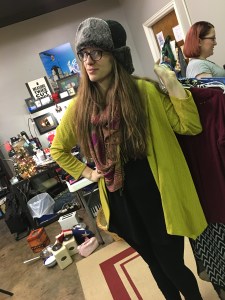 “It’s like you get to go shopping without spending any money”. – Katy Larsen
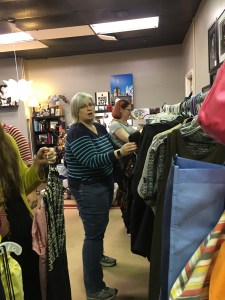 Encourage your friends to clear out their clutter. Give reminders about special events in town. Is it near a certain holiday? Make a suggestion to bring items that are in or off-season. Something that may seem silly might make for a great costume item.

 I often wish that I were a culinary artist. It’s not that I totally love the idea of cooking every night or even every other day. I just like having the feeling of accomplishment when I create a beautiful meal, and of course then get to eat it. A few months ago I attended my first “Cook the Book: Ducasse Made Simple” cooking class at
  So now, I am excitedly awaiting the “


 The day of the event, I only told four people (two of which were my kids) that I would be speaking that night. I didn’t want the pressure of people giving me encouragement and then bailing on them. I have struggled my entire life with shyness and social anxiety and this was going to be a huge step for me, although, at the time, I had no idea how HUGE. I practiced all day, recording on my iPhone and realized that there was no way that I’d be able to go through with it. My voice was just not there. I worried that no one would even be able to hear me. I was making myself sick with anxiety. As I sat in the audience waiting for my turn, I wasn’t sure until that last second if I could do it, and then I stood up. I walked to the stage and I started
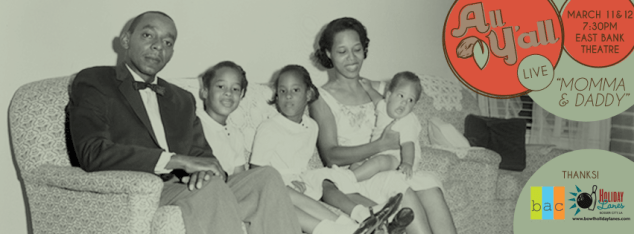

 Let me begin by saying that being blind is no joke. For an evening, I feigned blindness for the sake of learning. As I was thinking of catchy blog titles and things to say, all of the “eye opening” references came to mind. But after the experience, I realized quickly that those silly little comments are not as funny as I originally thought. Imagine only seeing darkness, not being able to see the sun, or your child’s face when they are born. Think about how it would be not to see the food that you are eating.
 As my boyfriend Ed, and I approached the table, we immediately saw aprons and eye masks at each place setting. Not just any eye masks, but really swanky, light blocking masks with room for your eyes to blinks. I assumed that was so you would have the ability to keep your eyes open during the experience, while maintaining visual impairment. In the printed program, we found “tips and tricks” for successful dining. We’d need to rely on our other senses and abilities, introduce our table mates, imagine a typical place setting, keep contact with the table, and tips for using utensils and drink ware. What you need to know about me is that I go all in when I participate in events. Once my mask went on, there would be no peeking, so I ran through the tips and got ready to start eating blindly.
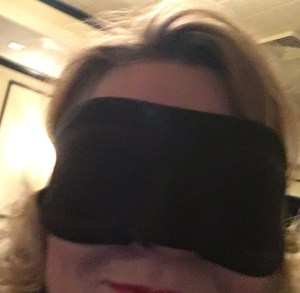 Self-consciousness, vanity and confidence: My normal self-consciousness would be challenged if I ever became blind. I noticed as I was sitting at the table I didn’t have much control over what my hair looked like or if my décolletage was exposed. I dropped my salad fork before I ever started eating, and my confidence was not very high that I would be successful in feeding myself.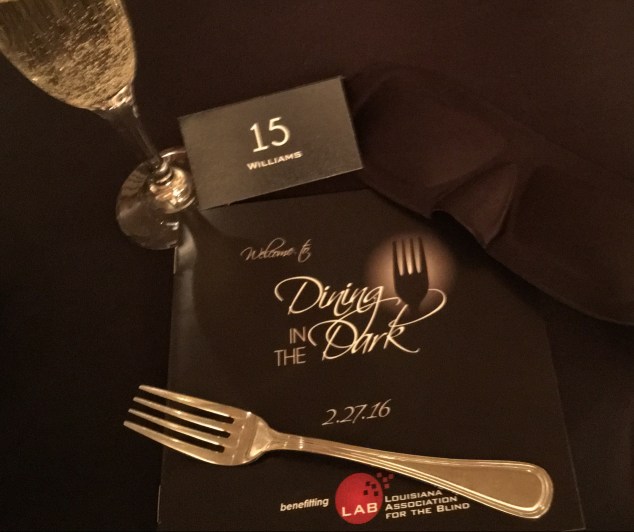

 Do you have something that makes you cringe when you hear it? Something that drives you to roll your eyes and stomp your feet? I sure do. When I hear the phrase “there’s nothing to do in Shreveport-Bossier, Louisiana” I have to restrain myself from completely wigging out. You see, when I first moved to Shreveport-Bossier, I will admit that I said it myself. I moved here from South Louisiana and I really just wanted to go home. For many years, I went to work and then headed straight to my house. On occasion, I looked to the arts and entertainment section of the newspaper to find things that might be of interest to my family. I didn’t know many people that could help connect me to the community, so I just stayed home. That was then. And now, I subscribe to the thought that there are things to do wherever you may be.
 This website has been around for a while and was already one of my go-to sites, and in particular, the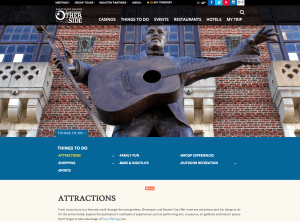


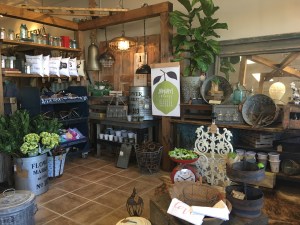 I’m super excited to share about a new business in Bossier City.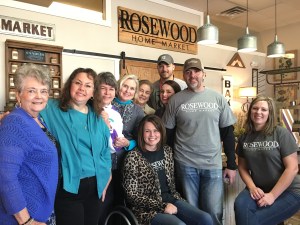
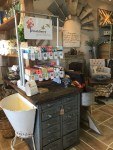


 I was interested to find out that Rosewood Home Market will be carrying locally grown flowers in the Spring. I’m a flower girl. Flowers make me smile! I’ve always wanted a place to stop in and grab a bunch of naturally grown blooms to cheer up my house and as gifts for my friends. Farm to store. Cut flowers. Not bred for shipping. This will be such a treat.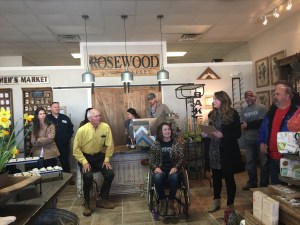
 Rosewood Home Market is located at 2850 Douglas Drive Suite A in Bossier City, LA. Stop by and find something special for your home.
 That Just Happened