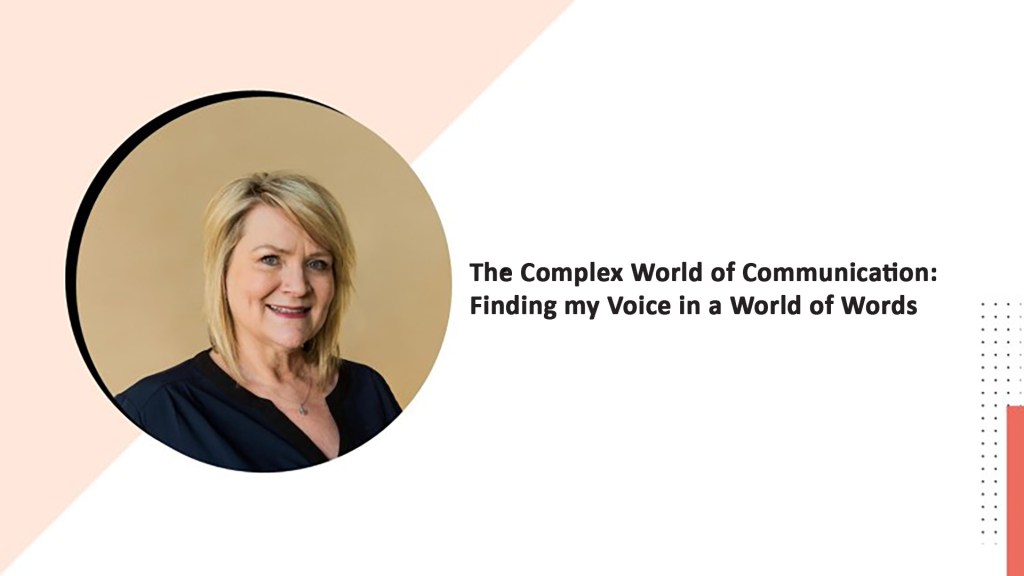
The Complex World of Communication: Finding my Voice in a World of Words

In the realm of communications, the expectation is often that we are masters of all forms of expression. However, the reality is more complex and distinctly human. For me, the challenge of speaking my thoughts out loud has always been significant. While my role demands seamless and effective communication, there’s a personal hurdle that is quite frustrating: my brain’s reluctance to cooperate with my mouth in real-time conversations.
I believe that this difficulty partly stems from growing up in an environment where my opinions were often stifled, and my voice felt disregarded. In a setting where articulating one’s thoughts was not welcome, my brain learned to hesitate before syncing with my mouth during real-time conversations.

This disconnect isn’t about knowledge or capability; given some time, I can compose a written piece that accurately reflects my thoughts and intentions. Writing allows me the luxury of time to organize my thoughts, choose my words carefully, and revise until the message is just right. Writing gives me the space to structure my ideas, select the right words, and refine my message until it’s just right. With the introduction of ChatGPT, I now have a new resource to even further improve and convey my written communication pieces more clearly. But when it comes to the immediacy required in verbal exchanges, that’s where my struggle lies. My mind, buzzing with ideas and responses, somehow hits a roadblock when asked to articulate those thoughts on the spot. 

There’s an added layer to my communication: the tendency to shut down in conversations. At times, rather than attempting to engage in dialogue, I find myself withdrawing, leading others to mistakenly assume I’m upset or distant. This reaction isn’t borne out of frustration or a lack of interest but is a manifestation of my brain’s struggle to cooperate in the moment. It’s a defense mechanism, one that I’ve been working to understand and address.

It’s a peculiar position to be in, especially when your profession centers around communication. The irony isn’t lost on me. In a world that increasingly values quick, off-the-cuff responses, this challenge can feel like a significant obstacle. Yet, it’s also been a profound learning journey, teaching me the value of patience, preparation, and understanding my own communication style.

Recognizing this challenge—and its roots in my upbringing—has pushed me to develop strategies to bridge the gap between my rapid-fire thoughts and their verbal expression. I’ve learned to lean into the strengths of my written communication, using it as a foundation to build confidence in my spoken words. Preparing key points ahead of time, practicing out loud, and allowing myself to pause and think during conversations have all been invaluable tools.

This journey has also led me to appreciate the diversity of communication styles within the corporate world. We often celebrate the quick thinkers and smooth talkers, but there’s immense value in those who take their time, crafting thoughtful, well-considered responses. It’s a reminder that effective communication isn’t about speed but about connection and understanding.

For those who might share this struggle, know that you’re not alone. Embracing your unique communication style, recognizing your strengths, and working patiently on your challenges can turn perceived weaknesses into unexpected strengths. It’s about finding your voice, even if that voice prefers to express itself in writing before speaking.

In embracing this personal challenge—and understanding its roots—I’ve not only become a better communicator but also a more empathetic colleague. Understanding my own struggles with communication has deepened my appreciation for the diverse ways people express themselves and connect. It’s a journey that continues to teach me about resilience, adaptability, and the power of finding one’s voice, in whatever form that may be.


 This article was originally posted on LinkedIn on February 22, 2024


Chatbots, Blogs, and the Fear of the Unknown: A Communication Specialist’s Personal Journey into AI

I’ve been wanting to share this for a while now, but I’ve honestly been worried about what my colleagues might think. I’ve been in marketing and communications for a long time. I’ve seen a lot of things change in this field, but I must say that nothing has been as intriguing and, at the same time, unsettling, as the advent of AI-powered tools like the GPT (Generative Pre-Trained Transformer) technology.

My first text to image attempt

In March 2023, I was introduced to Chat GPT during a company-initiated AI generative challenge. The experience was exciting and educational for me. This was a completely new concept to me. I was genuinely captivated by the poetry and various text-to-text generation demonstrations showcased by colleagues that day.

After that event, I started exploring GPT’s capabilities and found that it could be a useful tool for my tasks. Specifically, I found it valuable for aiding in writing blog posts. The interaction with GPT was not only intriguing but also significantly beneficial for my work. Since that time, I’ve been experimenting with Chat GPT and Google Bard to assist in writing content. There, I said it. It’s out there now. I know, I know. You’re probably thinking, “Are you outsourcing your work to a robot?” Believe me, I’ve asked myself the same question, and I’ve grappled with the implication.

There’s an undercurrent of fear, isn’t there? It’s like we’re walking a tightrope between embracing the future and clinging to the familiar. I’m thrilled by the prospect of AI, but also anxious about what it could mean for my job in Communications. I’ve been filled with anxiety worrying about whether I’m paving the way for my own redundancy. As a Gen Xer, I’m already worried about my relevancy in the workplace without being worried about whether my role as a writer will become obsolete.

But here’s the thing. As I’ve been using GPT, I’ve realized that it’s not about replacement, it’s about collaboration. AI doesn’t “take over” the job. It’s not sitting in a dark room somewhere, churning out blogs with a sinister robotic grin. It’s a tool, a helper. It generates ideas, provides suggestions, and helps to streamline the creative process. It’s like having a brainstorming partner who never gets tired or runs out of coffee, or in my case, Diet Dr Pepper!

I’ve been amazed at the speed and efficiency with which I’ve been able to create content. It’s allowed me to focus on the parts of my job that truly require human insight and emotion. I’m still navigating this new terrain, still learning how to best use this tool, and still occasionally worrying about the future. But isn’t that the essence of life? Constantly evolving, constantly learning? As I began this personal journey, I started thinking about reasons why I’m hesitant and why I’m excited about generative AI.

Reasons why I was hesitant to use generative AI for Communication Content Creation:

  • I’m worried what people will think of me. I’m worried people will think I’m a fraud by using the assistance of generative AI. I’ve always had imposter syndrome, and I think this is just going to add to the feeling of not being good enough.
  • I’m worried about the quality of the content. Generative AI models are still under development, and they can sometimes produce inaccurate or misleading information. Many models have knowledge data that is limited to new or events up to 2021. (things are changing daily though. As I waited for approval for this article, GPT-4 was released)
  • I’m worried about the ethical implications of using generative AI to create content. For example, could generative AI be used to create fake news or propaganda? This is a real problem. Remember you are ultimately accountable for the content that you publish.
  • I’m worried about the impact of generative AI on my job. If generative AI can do my job for me, what will happen to my job? I really love and need my job!!

Despite my concerns, I believe that generative AI can be a positive experience for communication professionals.

Reasons Why I think Generative AI for Communication Content Creation Can Be a Positive Experience:

  • It can help me create content quickly and easily. Generative AI can help me generate ideas for content, write content, and even edit content. This can save a lot of time and effort. This can also be a huge benefit for communications teams, which are often understaffed and overworked.
  • Generative AI can help create more engaging content. Generative AI can help create more engaging content that will capture the attention of employees and create content that is tailored to different audiences. This can help reach employees who might not otherwise be interested in content.
  • Generative AI can help create more accurate content. Generative AI can help create more accurate content (identify and correct errors in content) by drawing on a vast amount of data. This is especially beneficial for communications teams, which often need to share accurate and up-to-date information with their employees.

If you’re considering using generative AI to create content, here are a few tips to help you use it effectively:

  • Be clear about your goals. It’s worth considering how you plan to use GPT. Do you want it to take on all your routine tasks, or do you see it more as a tool for specific tasks? What do you want to achieve with your content? Once you know your goals, you can start to think about how generative AI can help you achieve them. I personally only use it to help refine the stories or social media posts that I have already created and want to be fine-tuned. I may change in the future, but for now that’s my plan.
  • Do your research on tools. There are different generative AI tools available. Do some research to find the tool that is right for you. I currently use the paid version, Chat GPT Plus, and Google Bard for blog content creation. I also routinely try out other platforms to get an idea of what they offer.
  • Test different approaches. Don’t be afraid to experiment with different approaches. See what works best for you and your audience.
  • Be prepared to edit. Generative AI can help you create content quickly and easily, but it’s important to be prepared to edit the content. Generative AI is not perfect, and it can sometimes produce errors. It’s important to merge Human Intelligence with Artificial Intelligence. Make sure it captures your personal voice and personality, company’s culture, brand voice, and the nuances that go into effective communication.
  • Watch out for repetition: Generative AI can sometimes get caught in a repetitive loop. Watch for repetition of similar phrases or sentences.
  • Do your research with your content. Many GPT models have knowledge data that is limited to new or events up to 2021, so it is important that you still research your information as you would with any other content. As I mentioned above, GPT-4 was recently released which will greatly improve access to information. However don’t rely on GPT alone.
  • Writing prompts: While AI can generate content from a prompt, we must use our creative agency to maintain control over the final output. I find it works best for me to draft an initial story and have the AI fine tune it for me. I then infuse it with my own tone, style, and personality. It’s all about finding a balance that suits your individual writing style.

While I may have my worries and doubts, I am excited about the potential of this technology. GPT, chatbots, AI – these aren’t threats, they’re opportunities. Opportunities for us to evolve, to grow, and to improve our work.

Remember, every tool is only as good as the person using it. AI is just that – a tool. And as we move forward, it’s up to us to determine how we use it, to ensure that it benefits us, our work, and ultimately, our audience. Learn as much as you can about this technology and use it ethically. AI and human intelligence can work together to create something truly amazing.

Change can be scary, but stagnation is scarier. So, let’s embrace the new, and navigate this brave new world together. After all, we’re in the business of communication, and what’s more communicative than sharing our experiences, fears, and hopes for the future?


This article was originally posted on LinkedIn on May 30, 2023